· projects, git
Lore
A commit log tells you what changed, one commit at a time. Seeing how those changes fit together over months and hundreds of files is harder. I built Lore to try a different view.
Give it a public GitHub repository and it builds a 3D view of its files over time. A point is a file. Files that change together sit together. A 90-second tour takes you through the history in chapters, and you can pause to explore on your own. There is also a gallery of 24 repositories to try. The source is on GitHub.
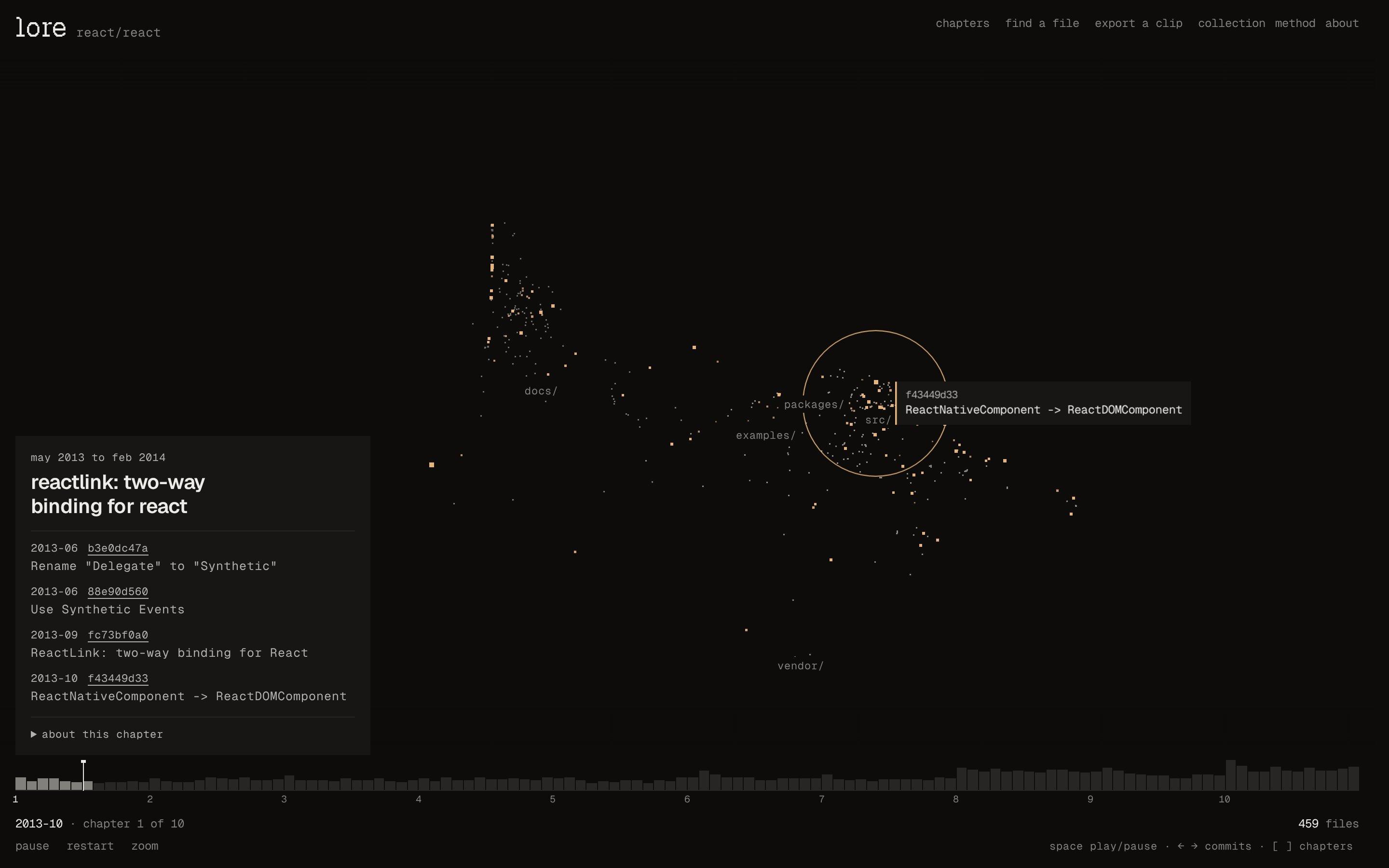
What belongs next to what?
A component and its tests might change together for years while living in different directories. A directory tree shows their paths, but not that relationship.
Lore connects files that change in the same commits and uses those connections to position them. This is called co-change. It is a clue, not proof of a dependency. A large commit can touch unrelated files, and related files do not always change together.
File positions stay stable during playback. Files appear, change, and disappear without the whole layout rearranging at every commit.
Reading Git's history
Git history is a graph, not a single timeline. Lore makes a timeline by following each commit's first parent. At a merge, it shows the resulting tree, including the merged changes. You see successive repository states, not every commit from every branch.
Lore also tracks files through renames where there is enough evidence. Reusing an old path for a different file should not turn the two into one object on screen.
A tour with receipts
The tour splits the history into at most ten chapters. It looks for changes such as a new part of the tree that keeps getting work, or a word that becomes common in commit subjects and stays common. Each chapter gets an equal share of the 90 seconds, regardless of its commit count.
Each chapter shows two to four commit subjects, with dates and short commit IDs linking to GitHub. A language model picks the commits and chooses one to name the chapter. It does not write a summary. The title comes from the chosen commit's subject, with any conventional-commit prefix and pull request number removed.
Playback slows at each of those commits. The files it touched light up, a ring surrounds them, and the camera moves closer. You can see where the change landed.
The model's selection is still a judgment, not a verified account of the architecture or why a change happened. You can follow the links and read the commits yourself.
A shared link pins a particular revision, so another reader opens the history at the same revision rather than a moving default branch. In Chrome, you can also try a 20-second video export, though it may fail. If the 3D view is unavailable, the app has a static view.
Lore builds on tools like Gource, which animates repository activity, Git Truck, which explores structure and history, and Gource View, which brings animated history to the browser. Lore combines a co-change layout with playback and chapters linked to commits.
This is a first version. The layout and gallery still need human review, and I expect the visualization to change as that happens.